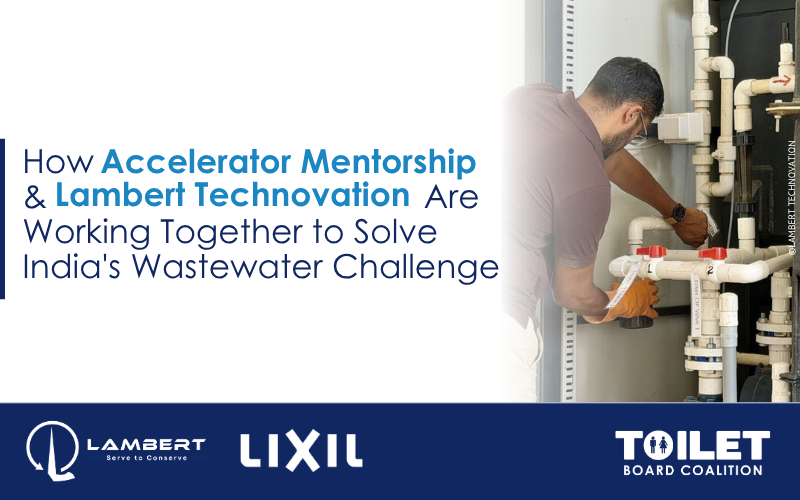
A Toilet Board Coalition story — Lambert Technovation x LIXIL
The Challenge That Inspired Lambert Technovation
Across India’s industrial and municipal sectors, wastewater treatment remains one of the most complex and consequential challenges to address at scale.
For Abhijeet Kumar, Founder of Lambert Technovation, that reality became the founding question: what would it look like to build treatment technology entirely around the needs of the people using it? Not an adaptation of what already existed, but something genuinely new — modular, chemical-free, compact, and simple enough that a facility could deploy and operate it without becoming a water treatment specialist in the process. Lambert was built to answer that question, with the ambition of transforming complex wastewater and industrial cooling water into reusable resources whilst helping industries, data centres, municipalities, hospitals, and buildings move towards a net-zero approach to water management.
The First Conversation
When Anandita Kakkar, Marketing Leader at SATO, LIXIL, was introduced to Abhijeet through the Toilet Board Coalition’s Accelerator programme, she arrived with a sense of open curiosity.
What she found was a founder who did not lead with a pitch. Abhijeet talked about the problem first; about the specific, on-the-ground conditions that existing treatment systems consistently fail to address, and about what it had taken to design something that could meet those conditions without compromise. There was a precision to how he described the challenge, and a quiet conviction behind it, that made it immediately clear this was not simply a business he was building. It was something he felt a genuine responsibility to get right.
For Anandita, whose work in marketing communications has long been anchored in the belief that the right story, told well, can change how people engage with a cause, that clarity of purpose was immediately recognisable. “What stood out immediately,” she recalls, “was the clarity of vision and the drive. Within the first few minutes of our chat, they knew what they wanted from this mentorship and had shared their plan for the whats coming next.”
It was, she says, the kind of first conversation that makes the work of mentorship feel worthwhile before it has even begun.
The meeting itself was made possible through the Toilet Board Coalition’s Accelerator, where mentors from Member organisations work directly with sanitation entrepreneurs to help strengthen strategy, scale impact, and navigate growth challenges.
How Lambert Technovation Approaches the Problem
Lambert’s guiding principle is straightforward: every customer’s needs are different, and effective treatment must begin with genuine understanding of those needs. The company’s process reflects this at every stage; starting with site visits and laboratory analysis of water samples, producing treatment schematics specific to each client’s effluent profile, and offering onsite demo trials before any full-scale system is deployed. Only once results have been verified by the client does Lambert proceed to installation.
The Water Battery, an electrochemical reactor, is plug-and-play: two steps to install, no specialist chemicals required, and designed to operate with minimal human intervention. It can function as an upgrade to an existing system or as the foundation of a completely new one, and it is suited to a wide range of sectors — from textiles and pharmaceuticals to hospitals, hotels, data centres, cooling systems, municipalities, and beyond. After installation, Lambert’s engineers remain engaged, providing training, consumables, and ongoing remote support.
Lambert reports that in practice, the Water Battery treats wastewater in seconds rather than hours, up to 200 times faster than conventional plants, in roughly a quarter of the footprint, with 40% lower operating cost and half the sludge.
Alongside the Water Battery, Lambert has built Lamcell, a parallel reactor for cooling-tower water that suppresses scaling and biofouling without chemical dosing, extending the same modular, chemical-free philosophy to industrial cooling and data-centre water use.
What distinguishes Lambert’s approach is its refusal to treat wastewater treatment as a one-size-fits-all infrastructure problem. The company approaches every project with what it describes as “a blank sheet of paper and an open mind”, recognising that every site, every effluent stream, and every operational challenge requires a different response. For Abhijeet, that philosophy is central to what sets Lambert apart:
“Wastewater treatment in India has been sold the same way for the last hundred years. Big civil works, chemical contracts, hours and days of retention times, and a customer who has to learn the system to keep it running. We built Lambert to invert that. Modular, chemical-free, second-scale treatment, with our engineers staying engaged after installation. The customer’s job is to run their facility. Ours is to run the water.”
Why Speed in Wastewater Treatment Is Important
Lambert’s approach to pace is deliberate. As India’s industrial and municipal sectors grow, so too does the urgency of ensuring that water treatment keeps up. The need for solutions that are fast to deploy, simple to operate, and accessible in cost is both pressing and clear, and it is this need that Lambert was built to address.
This is why the modularity and simplicity of the Lambert reactors are not merely design features. They are a strategic stance on what it will actually take to close the treatment gap in India. A system that requires months of civil works, specialist chemicals, and significant operational complexity is, in practice, inaccessible to a large proportion of the facilities that need it most.
Lambert’s philosophy is built around the belief that accessibility and performance are not in tension. A treatment system should not have to become more complicated in order to become more effective.
The ambition behind this is a genuinely circular approach to water: not simply treatment for compliance, but the transformation of wastewater into a resource that can be returned to use. That is what Lambert is oriented towards, and it shapes every decision the company makes about how its technology is built and deployed.
For Anandita, these conversations shifted the way she thought about wastewater treatment itself. What initially appeared to be a technical discussion increasingly revealed itself as a question of accessibility, public health, and long-term sustainability.
What the Mentorship Is Producing
Working with Anandita has given Abhijeet something that technical expertise alone cannot provide: a thinking partner who engages with the full complexity of building a company in service of a significant public challenge, and who brings both rigour and warmth to that engagement.
Their conversations have moved across strategy, market positioning, and the practical decisions that determine whether a promising technology reaches the scale it deserves. Anandita has brought her experience of navigating large organisations to bear on questions that matter to Lambert’s growth, and she has done so as someone genuinely invested in the outcome, not simply fulfilling a programme requirement.
For Abhijeet, the relationship has also reshaped how he approaches leadership and growth within the business. As he reflects:
“I came in thinking like a tech founder. If the technology is right, the rest will follow. Anandita pushed me to see that the technology is only one half of the work. How clearly we communicate it, how we structure the team around it, and how the customer encounters it for the first time, all matter just as much. Anandita has a way of asking the question I have been avoiding, and that has changed how I plan.”
The Ecosystem That Enables This
What Anandita brought to Lambert Technovation in expertise and strategic perspective, the relationship returned to her in equal measure, a closer understanding of what it takes to build technology that serves a public purpose, and a renewed appreciation for the kind of founder who is passionate about accelerating impact on SDG6. Reflecting on the experience, she says: “The difference is skin in the game. When the work is about clean water access, every conversation carries real weight. That accountability made me a better mentor and honestly, a more grounded one. There’s something about working with a young founder who has everything to prove that sharpens you. Their urgency is infectious; my experience gave it direction and somewhere in that exchange, we both grew.”
This is what the Toilet Board Coalition’s Accelerator makes possible. Founded in 2015, the Coalition accelerates business solutions to the global sanitation crisis, facilitating partnerships between SMEs, corporates, NGOs, investors and governments committed to achieving universal access to sanitation and hygiene by 2030. Through its Accelerator, which has to date graduated 111 enterprises, impacted more than 13 million people daily and unlocked US$49 million in finance, the Accelerator connects Sanitation Economy entrepreneurs with senior professionals from Member companies who bring the skills of the private sector to bear on some of the most pressing public challenges of our time, committing their expertise to help founders grow their businesses and extend their reach.
The match between Anandita and Abhijeet is one example of what that can look like in practice. A collaboration grounded in shared purpose and a clear-eyed commitment to the work that still needs to be done.
To learn more about the Toilet Board Coalition Accelerator and register for the next cohort, visit the website.