Menstrual health is fundamentally linked to water and sanitation systems. Yet millions of women and girls do not have access to safe water and sanitation to manage their menstrual health and hygiene. Inadequate sanitation and hygiene limit women’s and girls’ ability to manage menstruation safely, affecting health and contributing to school absenteeism, reduced workforce participation, and long-term barriers to economic independence and professional integration.
This reality sits at the heart of World Water Day 2026, whose theme “Water and Gender, where water flows, equality grows” highlights how water challenges disproportionately affect women and girls and calls for women’s equal voice and leadership in water decision-making.
Tendryl Products™ was born in this gap between rights and reality. From pioneering sanitary napkin vending machines using prepaid smart cards to building sustainable menstrual hygiene solutions under its PINKZ® brand. From two founders driven by purpose, Tendryl has grown into a mission-led enterprise anchored in access, education, and dignity. Today, the organisation works towards its mission of supporting and uplifting 100 million women across India by 2030.
The Start of the Journey
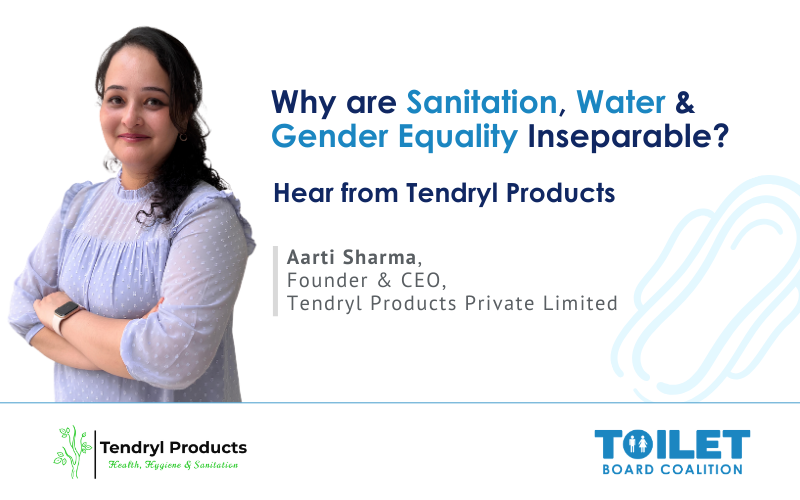
Having grown up in a home where menstruation was never treated as taboo, Aarti had long believed such openness was universal. But as she spent time in schools and communities across India, speaking with women and girls about menstrual health, she began to encounter stories that challenged that belief.
Around this time, her future co-founder Lakshman approached her with the idea of building a solution to address menstrual hygiene challenges in India. Before committing, Aarti chose to spend time understanding the realities on the ground. She travelled through urban, semi-urban, and rural communities, listening to women speak candidly about menstruation, access to hygiene, and the daily compromises they were forced to make. These conversations revealed not only gaps in access to menstrual products, but a deeper intersection between sanitation, water, and gender equality.
One moment in 2017 brought these insights into sharp focus. Inside a school in Dharavi, Mumbai, Aarti and her co-founder Lakshman piloted their first sanitary napkin vending machine — an early experiment that quietly transformed how young girls accessed something many of us take for granted. For the students who used it, menstrual health products represented far more than availability alone; they offered privacy, dignity, and the freedom to manage their periods without fear or shame.
Those insights eventually shaped the creation of Tendryl Products™, formally established in 2022 to build sustainable menstrual hygiene solutions rooted in access, dignity, and education. Tendryl’s journey offers a grounded example of what a rights-based, gender-responsive approach can look like in practice.
One that acknowledges women as informed participants, leaders, and architects of solutions that shape their health and futures.
Q&A with Aarti Sharma, Founder and CEO of Tendryl Products™
Q1. Tendryl began with a deeply personal and social problem. What moment made you realise this was something you had to build?
AS: I grew up in a progressive family where menstruation was never treated as a taboo. It was openly discussed at home, even between daughters and fathers, and it wasn’t unusual for our father to run to the pharmacy to buy sanitary pads. For a long time, I assumed this was the reality for most girls.
It was only later in life that I realised I had grown up in a bubble.
The turning point came when a migrant worker who worked in my home was forced to undergo a hysterectomy due to complications linked to poor menstrual hygiene. That experience made the gap painfully visible. At her request, I began speaking with women in her community about menstrual hygiene and sanitation, and I realised how limited access, awareness, and infrastructure truly were.
Around that time, my co-founder Lakshman approached me with the idea of building a solution in this space. Before committing, I spent nearly two years travelling across communities, meeting young girls, women, and institutional decision-makers to understand the realities they faced.
What stayed with me most during those field visits was not just the lack of access to sanitary products, but the silence surrounding menstruation. Girls would miss school, improvise with unsafe alternatives, or simply endure discomfort because there was no system around them that acknowledged their needs.
One installation in a school in Dharavi brought this into sharp focus. When the vending machine was introduced, the response from the girls was immediate — relief, curiosity, and a sense that someone had finally thought about them.
That moment reframed the problem for me. It wasn’t just about providing a product. It was about dignity, agency, and building systems that recognise menstrual health as a normal part of everyday life.
Q2. Why must menstrual health be treated as a core part of water and sanitation systems, rather than as a separate health issue?
AS: Menstrual health is fundamentally linked to water and sanitation systems — both in India and globally.
Managing menstruation safely requires access to clean water, private and functional toilets, and safe systems for disposal. Without these basic services, access to menstrual products alone cannot solve the problem. Women and girls need spaces where they can wash, change, and manage menstruation with dignity.
In India, this challenge is visible in schools, workplaces, and public sanitation infrastructure, where facilities often exist but are not designed with menstrual health in mind. Across many parts of the world, particularly in low- and middle-income countries, millions of women and girls still lack reliable access to water and sanitation altogether.
When menstrual health is overlooked in sanitation planning, the consequences extend far beyond hygiene. Girls may miss school during their periods, women face increased health risks, and participation in education, work, and public life becomes more difficult.
Recognising menstrual health as an integral part of water and sanitation systems shifts the conversation from a private or cultural issue to a public infrastructure challenge. It also highlights the importance of designing solutions that reflect the lived realities of women and girls — ensuring that water, sanitation, and gender equality are addressed together rather than in isolation.
Q3. How has your experience as a woman founder shaped the way Tendryl designs solutions and advocates for menstrual equity?
AS: Being a woman founder has meant approaching the problem with lived understanding and deep listening.
Menstruation affects girls as young as 11 and women well into their late forties and early fifties. Women also come from diverse backgrounds, abilities, and lived realities. Recognising this wide spectrum was central to how we approached the design of our solutions. From the outset, accessibility was a key consideration in our vending machines — ensuring they could be used easily, privately, and with dignity by women and girls across different settings. It has been one core design but refined through many iterations shaped by real user feedback.
We also recognised early on that access to menstrual products is only the first step. For menstrual hygiene systems to work sustainably, they must ensure a continuous cycle — reliable access to supplies, supporting services for maintenance and replenishment, and safe disposal mechanisms. Our approach has therefore focused on building an ecosystem where access comes first but is supported by ongoing service models and responsible disposal solutions, ensuring the system keeps functioning rather than becoming a one-time intervention.
Many sanitation solutions historically have been designed without consulting the people most affected by them. For Tendryl, our starting point has always been conversations with women and girls in schools, workplaces, and communities to understand what access, privacy, and dignity mean in practical terms.
Alongside infrastructure, continuous awareness and education are equally important. When these elements come together — access, supplies, services, disposal, and education — the system becomes self-sustaining and truly responsive to women’s needs.
It also informs how we think about menstrual equity. Women should not only be beneficiaries of sanitation systems, but active participants in shaping them — as decision-makers, entrepreneurs, and leaders.
Q4. Women-led sanitation enterprises often face systemic barriers. What were the biggest ones for Tendryl, and how did you navigate them?
AS: Building a sanitation enterprise meant working at the intersection of public health, infrastructure, and behaviour change sectors that historically receive limited attention and investment compared to mainstream technology or consumer businesses.
One of the earliest challenges was credibility. When you are introducing solutions around menstruation and sanitation, particularly as a woman founder, the issue itself is often considered niche or uncomfortable to discuss. Convincing institutions that menstrual hygiene infrastructure deserves the same seriousness as any other public health investment required persistence and evidence from the field.
Another challenge lies in the fragmented nature of sanitation ecosystems. Access to products alone does not solve the problem; it requires coordination between institutions, facility management, maintenance services, and responsible waste disposal systems. Building solutions that function reliably within these environments meant working closely with schools, workplaces, and local stakeholders to ensure that installations were supported by long-term operational systems.
Financing and scaling also present structural hurdles for sanitation enterprises. Impact-driven businesses often operate in spaces where commercial returns and social outcomes must be balanced carefully. Access to patient capital, partners who understand the long-term value of sanitation infrastructure, and ecosystems that support responsible scaling have become essential.
For us, navigating these barriers meant staying deeply connected to the communities we serve while steadily building institutional partnerships and operational credibility. Over time, consistent implementation, strong service models, and measurable impact have helped shift the conversation from viewing menstrual hygiene as a peripheral issue to recognising it as a critical component of public health and gender equality.
Q5. As Tendryl begins its journey with the Toilet Board Coalition Accelerator, what kind of support, capabilities, or networks are you most looking to strengthen through the programme?
AS: The Toilet Board Coalition brings together a unique ecosystem of sanitation innovators, investors, and global partners working to accelerate scalable solutions.
For Tendryl, the opportunity lies in strengthening three areas. First, deepening our understanding of how menstrual hygiene solutions can integrate more closely with broader sanitation and circular economy models. Second, learning from other enterprises that are addressing sanitation challenges in different contexts around the world. And third, building partnerships that support responsible scaling of solutions so they can reach more women and girls.
Equally important is engaging with an ecosystem that understands sanitation as both a social and economic opportunity. Access to networks, technical expertise, and impact-focused investment can help enterprises like ours expand sustainably while maintaining a strong focus on dignity and inclusion.
Sanitation innovation requires collaboration across sectors — from technology and design to policy, financing, and behaviour change. Being part of the Toilet Board Coalition Accelerator allows us to contribute to that collective effort while continuing to expand access to dignified menstrual hygiene solutions in India.
Tendryl’s journey illustrates what World Water Day 2026 is calling for: water is not just a resource — it is a foundation for sanitation, health, education, climate resilience, and gender equality. When women lack access to safe water, their opportunities shrink. When women lead solutions, systems become more inclusive and resilient.
Applications are now open for the 2027 Accelerator Cohort, supporting entrepreneurs innovating solutions across the Sanitation Economy value chain. Apply here.
Learn more about the World Water Day 2026 on United Nations Website and access campaign resources here.